Right now, the state of your boat lives in six heads
A whiteboard by the galley. A crew WhatsApp group. A spreadsheet one person maintains and
nobody else opens. Somebody's memory of what they did at 0400.
It mostly works, because your crew are good at their jobs. It stops working on crew change,
in the second week of a charter, and at every handover where the person who knew is asleep.
Then somebody walks a guest past an open hatch, or the passerelle light stays on all night,
or two people each think the other one closed it.
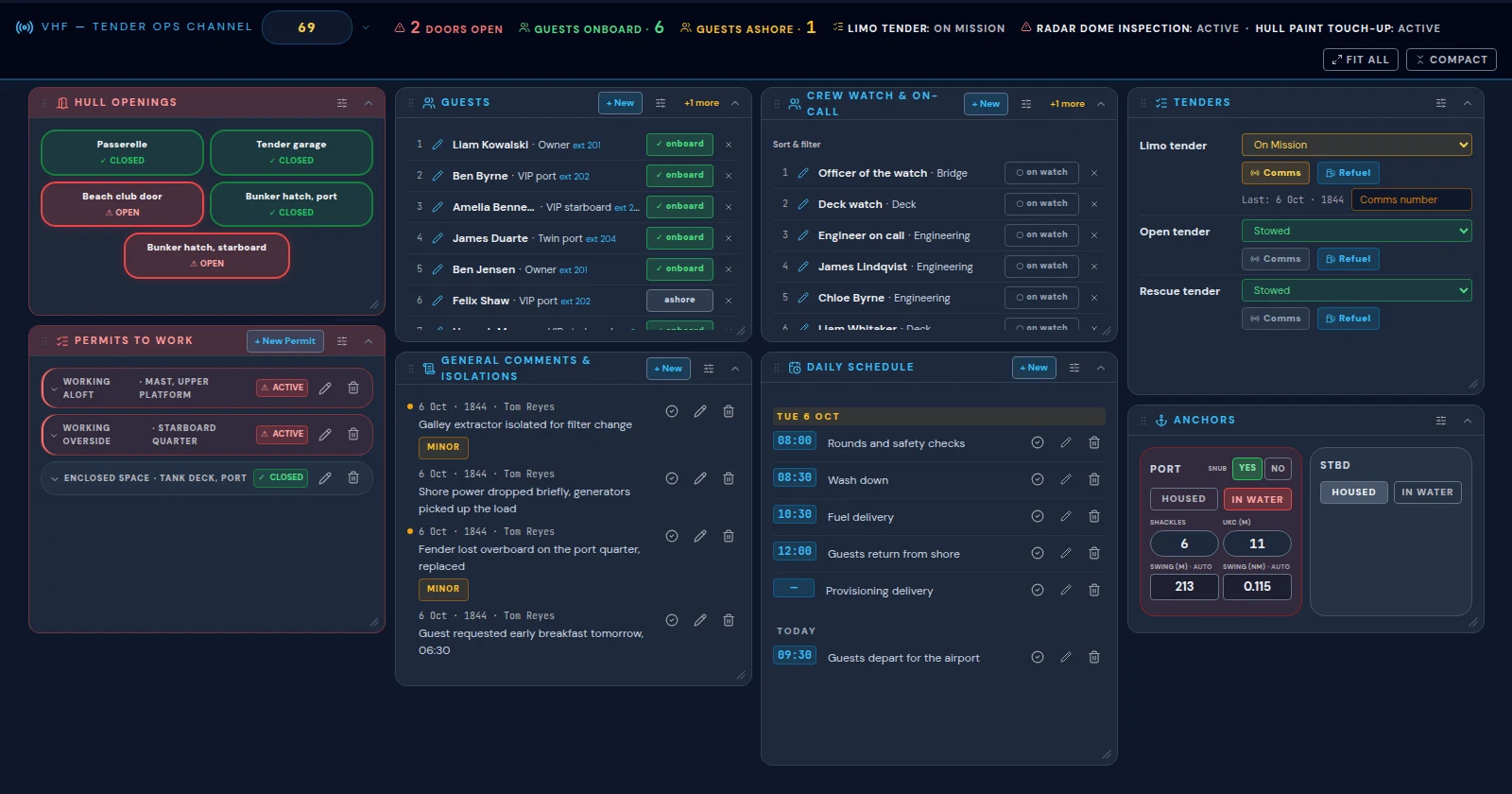
VesselOverview is one screen that holds that state, and every phone aboard can see it.
Ten years aboard, not ten years of site visits
I'm an ETO. Ten years working on yachts, standing the watches and being woken at 0300
because something tripped.
A contractor sees a boat for a week. They fix what they were called for, hand over a folder,
and leave before the crew change that undoes it. I've been on the other side of that one:
still aboard in week three, working out what the last person meant.
That's the difference in this product. It isn't a tidy model of how a vessel ought to run.
It's built around how they actually do, by someone who has to live with the result.
One board. Kept by the people who change things.
A demo vessel's board, with made-up crew and guests. Every entry says who changed it and when.
It says who, and when
Every change writes a log entry in the same breath as the change itself. Not a separate
step somebody forgets. The same action. You can see who shut the tender garage and at
what time, six weeks later.
It works on a bad connection
Plain forms, no clever client-side state. On a boat the link drops constantly, and a form
that either goes through or plainly refuses beats an interface that pretends it saved.
Corrections, not deletions
A log entry can be corrected for an hour after it's written, by the person who wrote it
or by an administrator at any time. The original stays. Nothing quietly disappears.
Shaped around your boat, not a template of somebody else's
Every yacht runs differently, and software that insists otherwise gets abandoned by week
three.
Your administrator sets up the panels the boat actually needs, in the words the boat actually
uses. If your crew say lazarette and not aft store, the screen says lazarette. If you care
about six hull openings and one passerelle, that's what's on the board, not a fixed list
somebody else decided was standard.
Your panels
Hull openings, tenders, watch, guests aboard, anchor. Add what you need, archive what
you don't. Archived, never deleted, so the history survives.
Your vocabulary
Item names, states and labels are yours. Nobody has to translate the screen into how the
boat actually talks.
Your rules
Per panel, decide whether any crew member can add an item or only an administrator. A
guest manifest turns over every charter; the hull opening list does not.
Who it's for
The captain
You want to know the state of the boat without asking three people, and you want the
handover to survive whoever was awake for it.
The purser or chief officer
Crew, who's aboard, who's on watch and where the cars are, in one place instead of four
spreadsheets that disagree with each other by Thursday.
The management company
Each boat you run gets its own board, billed and configured on its own, so you can see how
it stands without ringing the captain to ask.
What it isn't
Worth saying plainly, so you don't waste a call finding out.
It is not a planned maintenance system. It won't run your ISM or produce your surveys.
It is not a charter or accounts package. It doesn't touch bookings or money.
It is not a bridge or engine-room system. Out of the box it reads nothing off your NMEA network and controls nothing.
It will not fix a crew who don't tell each other things. It makes it obvious when they haven't.
If you need a planned maintenance system, buy one. This is the layer underneath it that the
whole crew touches every day.
What it costs
Per vessel, sized to your crew. Monthly, or annually with two months free.
Logbook
Up to 5 users. Cars, tenders and kit: who has it, fuel, bookings and trips. No status board.
£35per vessel, per month
or £350/yr billed annually, two months free
Crewboard: invitations, roles and removal
Equipment log: service history, bookings and printed codes